
Your starter is lively, your shaping is tidy, and yet the loaf still slumps into a wide, faintly apologetic pancake the moment it meets the oven. Often the missing piece is not technique but support: something to hold the dough while the gluten relaxes. A banneton — the coiled cane or pressed-pulp proofing basket — does exactly that for very little money. The snag is that baskets are sold in a fog of sizes, materials and liners, and the wrong one teaches the wrong habits. Here is what to check before you buy your first.
Fit the basket to your dough, not to the photograph
Bannetons are usually sold by diameter or by the weight of dough they hold, and the second number matters more. A round basket around 20 cm across comfortably takes roughly 700–800 g of dough; step up to 22–23 cm for loaves nearer a kilo. Oval baskets are measured along the long side, and a 25 cm oval suits a batard in the same weight range as that 20 cm round. Treat these as starting points rather than rules, then check the internal dimensions, because a thick coil can eat a centimetre or two of space.
Get the fit wrong and you will see it in the loaf. Too large a basket lets a slack dough spread sideways, so it bakes flat and wide with a pale, under-tensioned surface. Too small a basket forces the dough up over the rim; it bulges, takes on a pinched waist where the rim bites, and the top becomes an awkward mushroom that is hard to score cleanly. Aim for a shaped dough that fills the base, touches the sides, and still leaves a couple of centimetres of rim above it.
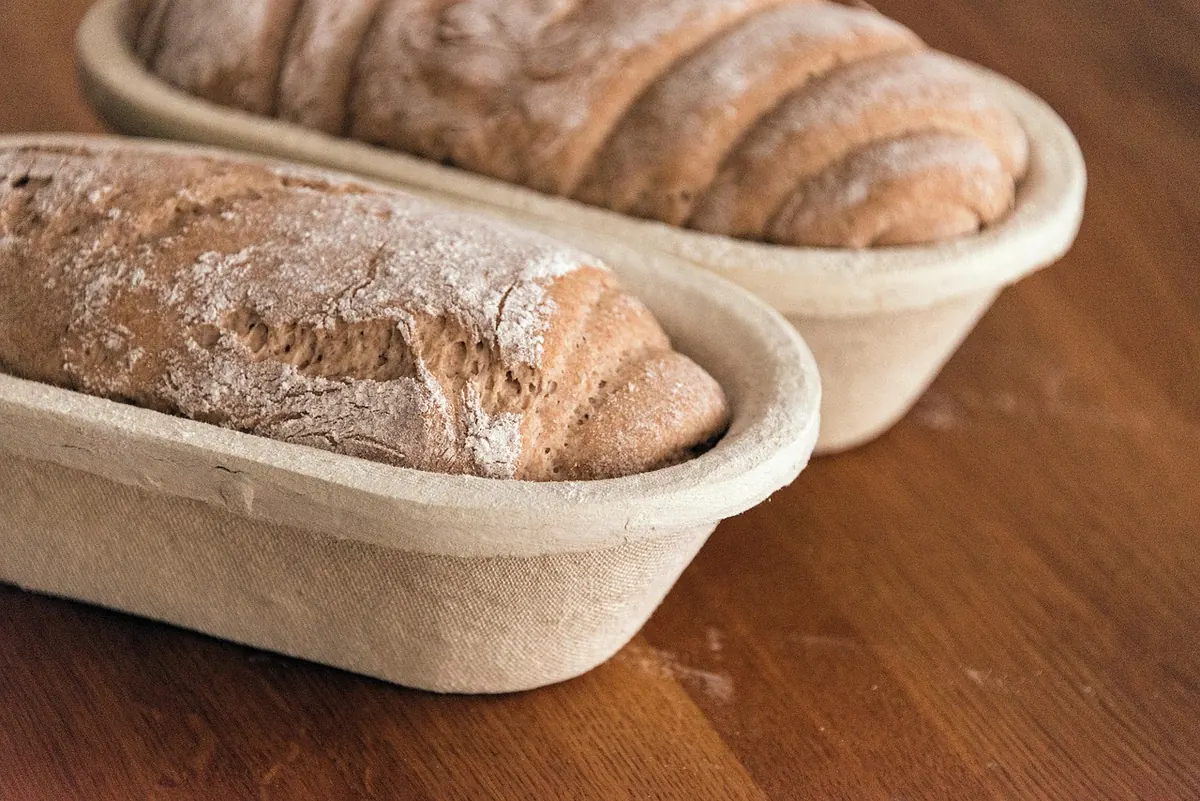
Think about shape as well as size. Round boules are forgiving: no corners, no direction to get wrong. Ovals give more even slices and fit a toaster, but they only look right if your shaping is consistent. They also impose a limit on your equipment — a 25 cm batard will not sit happily in a small round Dutch oven, so measure the pot before you fall for the basket.
Material: cane, wood pulp, and the plastic lookalikes
Most traditional baskets are coiled rattan or cane, stitched or glued into a spiral and often left with a hole in the base. They are stiff, breathe well, and last for years if you look after them. Expect a faint woody smell at first; it fades after a few bakes. Wood-pulp bannetons are pressed rather than coiled, with a smoother, denser surface. They wick moisture a little more evenly and suit wet, high-hydration doughs, though they can crack if they are soaked and dried too fast.
What to look for in the weave
- Tight, even coils with no loose ends to catch on dough
- A smooth rim — run a finger round it in the shop, or check the return policy if you buy online
- Visible gaps for air, not a sealed, varnished surface
- No strong chemical smell, which usually means a coating you do not want near your bread
Then there are the plastic and silicone “bannetons”. They are easy to wash and cheap, and some bakers like them for travelling or for freezing dough. But plastic cannot wick moisture away from the dough surface, so the loaf goes into the oven with a damp, sticky skin. Use one if convenience is what you need; do not expect the crust that cane gives you.
The liner question: cloth, rice flour, or both
Many baskets arrive with a linen or cotton liner, and some bakers never take it off. A liner keeps wet doughs from welding themselves to the cane, gives a smooth, soft-skinned loaf, and is easy to wash. Linen is better than cotton: it releases dough more cleanly and lasts longer. If you are baking very wet dough in your first month, a liner will save you a lot of frustration.
Bare baskets, on the other hand, are where the character comes from. Dust the coils generously with rice flour, or a half-and-half mix of rice and wheat, and the dough picks up the spiral pattern. Use rice flour rather than plain wheat flour for the basket itself: wheat hydrates into a paste against the cane and glues the dough in place, while rice flour stays dry and slippery. A light spray of water on the basket before dusting helps the flour stick.
A practical compromise: buy a basket with a removable liner, use the liner while you get used to a wetter dough, and switch to bare cane once your shaping holds. Keep the liner for high-hydration bakes and for the morning you forget to flour anything.
Cleaning: brush, dry, repeat
Bannetons are not meant to be washed after every bake. Turn the loaf out, let the basket air for half an hour, then brush the dried flour out with a stiff brush over the bin. Store it open to the air — a shelf, a paper bag, a breathable cloth — never sealed in plastic while it is still damp, which is how mould starts.
Every so often, give it a deeper clean: scrub with a stiff brush under a quick run of warm water, no soap, then dry it thoroughly somewhere airy and warm for a day or two. A barely warm oven with the door left ajar works; a hot one will warp the cane. A white bloom of flour is normal. Fuzzy green or blue patches, or a musty smell that lingers after drying, mean it is time to scrub harder or replace the basket. Liners should be washed cool, without fabric softener, and dried flat, since linen shrinks.
What the basket actually does to crust and shape
Two jobs, and both show up in the finished loaf. First, support. During the final proof the gluten relaxes and the dough softens; a basket holds the shape you worked for, so a slack dough stays a batard instead of becoming a puddle. Second, drying. The porous walls pull moisture from the surface of the dough, forming a thin, slightly leathery skin. That skin scores cleanly, opens predictably in the oven, and bakes into a thinner, crisper crust than dough proofed in a bowl. The basket also insulates gently, so dough retarded overnight in the fridge chills slowly and evenly.
The pattern is a bonus: spirals on a bare-cane loaf, a smooth floured surface with a liner. Neither changes the flavour, but both tell you at a glance how the proof went.
The checklist before you pay
- Write down the weight of dough in your usual recipe and the shape you bake most.
- Match the basket to that weight, then check the internal dimensions, not just the outer ones.
- Measure your Dutch oven or baking stone to be sure the loaf will fit.
- Choose cane for character and airflow, wood pulp for very wet doughs.
- Feel the rim and the coils for splinters and loose ends.
- Check whether a liner is included; a spare linen liner is worth having.
- Skip anything sold purely as kitchen decoration, and skip varnished or heavily coated baskets.
- Buy two of the same size if you bake weekly — you will want to proof one loaf while another bakes.
- Pick up a bag of rice flour at the same time; it costs little and prevents most sticking problems.
Start with one basket and five loaves
If you are still undecided, buy a single round cane basket around 20–22 cm with a linen liner, and bake five loaves in it before you buy anything else. You will learn how much flour your dough needs, how full the basket should look, and whether you prefer the smooth liner finish or the spiral of bare cane. Write the dough weight on the rim with a marker, keep a note of what worked, and let the second basket — probably an oval — be a decision you make with evidence rather than hope.
Photo: Feyza Daştan / Pexels